
"degree pole"
200 article(s) found

Basic knowledge of all aspects of coffee decaf coffee
Linnaeus (Swedish naturalist) classifies coffee plants into the Rubiaceae family, such as gardenia. The great naturalist named it Coffea. Although wild plants can grow as high as 10-12 meters, the plantations are about 3 to 5 meters high, with the exception of Colombia, where tree species rarely exceed 2 meters. This makes farming and picking easier and more economical to cultivate. Leaves

The basic knowledge of coffee encyclopedia on all aspects of coffee
Linnaeus (Swedish naturalist) classifies coffee plants into the Rubiaceae family, such as gardenia. The great naturalist named it Coffea. Although wild plants can grow as high as 10-12 meters, the plantations are about 3 to 5 meters high, with the exception of Colombia, where tree species rarely exceed 2 meters. This makes farming and picking easier and more economical to cultivate. Leaves

Basic knowledge about all aspects of coffee-baristas must see
Linnaeus (Swedish naturalist) classifies coffee plants into the Rubiaceae family, such as gardenia. The great naturalist named it Coffea. Although wild plants can grow as high as 10-12 meters, the plantations are about 3 to 5 meters high, with the exception of Colombia, where tree species rarely exceed 2 meters. This makes farming and picking easier and more economical to cultivate. Leaves

Is Italian espresso authentic? why is there no Starbucks in Italy?
Professional coffee knowledge exchange more coffee bean information please follow the coffee workshop (Wechat official account cafe_style) the coffee culture in Europe has a long history, among which Italy is the most popular. Italian's favorite is mellow espresso. In Italy, the essence of coffee is always concentrated in two words. Italy has a long and narrow territory, stretching from north to south to 1300km. Just like coffee beans.

Isn't it strange to have kebabs in the cafe and have a cup of Hot Tea, HK Style?
In a decoration style literature and art, similar to the coffee shop 100 square meters store, eating the most approachable spicy string, and then a cup of Hot Tea, HK Style, does it feel very strange? Although it is a spicy string, conscientious people will find that this is very similar to the Spicy Hot Pot we used to eat, except that the processing technology has been replaced by dry mixing. Recently, a lot of spicy shops have sprung up on the streets of Hangzhou.

Introduction to the Flavor of Coffee beans by Solar treatment
Professional coffee knowledge exchange more coffee bean information please follow the coffee workshop (Wechat official account cafe_style)

Costa Rican Tarazhu Coffee Flavor description A brief introduction to the planting situation of the processing side in the producing area of Grinding degree
Other coffees worth mentioning are JuanVinas,PR, H.Tournon, Windmill,SHB, Montebello and SsntaRosa. Fine coffee is generally grown in Geredia and the central canyon. Another eye-catching coffee is Sarchi coffee (sa).
"compared with iced coffee, hot coffee is the cooling artifact in summer!"
The temperature outside is close to 40 degrees Celsius, humid and muggy, and your sweat is even on the chair. At this time, you get up and make yourself a cup of steaming coffee. Wait, there seems to be something wrong with such a scene! Believe you in front of the screen, when it's so hot and sweaty, you want to stand in the air conditioner.

Introduction to the treatment methods for the Flavor description of Costa Rican Tarazhu Coffee varieties in the producing area of Grinding degree
The topography of Costa Rica is that the coast is surrounded by plains, while the middle is cut off by rugged mountains. The country declared 200 nautical miles in its exclusive economic zone and 12 nautical miles in its territorial sea. The climate belongs to the tropics and subtropics, and some of them are new tropics. Population [edited this paragraph] 4.27 million (2007). The official language is Spanish. 95% of the residents believe in Catholicism. In Costa Rica, only

Chocolate-flavored Niagara Los Congo Manor Coffee Flavor description Taste characteristics of varieties
The Nicaraguan national emblem was launched in 1971. The national emblem consists of three yellow edges symbolizing equality, truth and justice. The five green mountains symbolize Honduras, Guatemala, Nicaragua, El Salvador and Costa Rica, which used to make up the Central American Federation. Blue symbolizes the Pacific Ocean and the Caribbean Sea, which are separated by the Central American isthmus. The yellow on the top of the mountain reflects the volcanic plateau landform of the area. Stand on the green mountain
Ground coffee
one. Ground coffee in any good coffee shop, when you buy pure beans or mixed coffee beans, the owner may ask you if you need grinding. If you want to grind, you should tell him the adjustment method you use, because it will affect the degree of grinding. Of course, to extract the best flavor from coffee beans also depends on the ground coffee powder in hot water

Introduction of Coffee Variety characteristics and Grinding degree in Saint Roman Manor, Costa Rica
The topography of Costa Rica is that the coast is surrounded by plains, while the middle is cut off by rugged mountains. The country declared 200 nautical miles in its exclusive economic zone and 12 nautical miles in its territorial sea. The climate belongs to the tropics and subtropics, and some of them are new tropics. Population [edited this paragraph] 4.27 million (2007). The official language is Spanish. 95% of the residents believe in Catholicism. In Costa Rica, only

Understand the flavor and taste of coffee in Cuba's famous producing areas. Three major brands of Cuban coffee.
Professional coffee knowledge exchange more information about coffee beans Please follow the coffee workshop (Wechat official account cafe_style) Cuba, which has been growing coffee since 1820, is famous for its high quality coffee and has a long history. At that time, coffee beans were the number one exporter in the country, more than the sugar necessary for daily life, due to government policy and the chaos of the international political situation in the late 19th century.

Introduction to the processing methods of coffee flavor description in Costa Rican Goddess Manor
Colombia pursues a foreign policy of peace and neutrality, supports the principles of self-determination and non-interference in internal affairs of all peoples, attaches importance to the development of traditional friendly relations with Latin American countries, actively promotes the process of regional economic integration, and supports the establishment of the Free Trade area of the Americas. He was elected three times as a non-permanent member of the United Nations Security Council (1974-1975, 1997-1998 and 2008-2009).

Introduction to the planting Environment of the characteristics of Coffee Flavor Grinding degree in Los Congo Manor in Nicaragua
The Nicaraguan national emblem was launched in 1971. The national emblem consists of three yellow edges symbolizing equality, truth and justice. The five green mountains symbolize Honduras, Guatemala, Nicaragua, El Salvador and Costa Rica, which used to make up the Central American Federation. Blue symbolizes the Pacific Ocean and the Caribbean Sea, which are separated by the Central American isthmus. The yellow on the top of the mountain reflects the volcanic plateau landform of the area. Stand on the green mountain

Introduction to the taste of coffee beans produced in Diamond Hill Manor in Costa Rica
Costa Rica is located in the Central American isthmus at 10 degrees north latitude and 84 degrees west longitude. It is bordered by the Caribbean Sea to the east and the North Pacific Ocean to the west, with a coastline of 1290 km (212km on the east coast and 1016 km on the west coast). Costa Rica borders Nicaragua in the north (309 km long border) and Panama (639 km long border) south-southeast. There are 51100 in total.
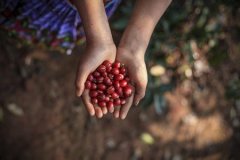
Brief introduction of Coffee Variety planting Market Price of Chocolate-flavored Coffee in Nicaraguan Heavenly Manor
Dry aromas are full of chocolate, with aromas of hazelnut and cocoa. The wet aroma also has the smell of chocolate, accompanied by the smell of orange peel. Under the baking degree of city+, the bright lemon acid and long cocoa aftertaste are very good. Generally speaking, Nicaraguan coffee is mild but not losing its flavor. Both Full city and Viennese are baked Nicaraguan coffee.

Introduction to the baking degree of high-quality coffee beans in El Salvador coffee producing areas
The Salvadoran flag was launched in 1822, rescinded in 1865 and restored in 1912. The Constitution of the year of the Salvadoran Flag in 1972 was officially established as the national flag. The national flag is rectangular, with a ratio of length to width of 335 to 189. From top to bottom, the flag is connected by three parallel equal horizontal rectangles of blue, white and blue, and the central part of the white part is painted with the national emblem. Because El Salvador used to be

Introduction to the characteristics of the fragrant and pure El Salvador boutique coffee bean flavor and taste manor
Salvador means savior in Spanish, named after Columbus's experience in discovering the American continent. The national flag of El Salvador was launched in 1822, was rescinded in 1865, was restored in 1912, and was officially established as the national flag in the 1972 Constitution. The national flag is rectangular, with a ratio of length to width of 335 to 189. A horizontal rectangle consisting of blue, white and blue parallel to each other from top to bottom.

Introduction to the flavor and taste characteristics of coffee from Nicaraguan Heavenly Manor with chocolate flavor
A city in southwestern Nicaragua and capital of Massaya province. Located at the eastern foot of Masaya Volcano, 25 kilometers northwest from Managua. The population is 43000 (1980). The industrial and commercial center of the surrounding agricultural area (which mainly produces tobacco). Famous for producing Indian handicrafts (embroidery, palm hats, etc.). There are tobacco, shoes, soap, leather and other industries. Rail, road and air transport facilities in Nicaragua